

Manipulating Factuality in LLMs Using ROME
Most developers treat a trained model like a compiled binary — something fixed and trustworthy once the weights are set. That assumption is wrong, and ROME is the proof. Model weights are mutable memory. A specific factual association inside a deployed model can be identified, modified, and made permanent without retraining, without additional data, and without leaving any external signal that the edit occurred.
The concern is not hallucination or incoherence. It’s the opposite: a model that answers one category of questions incorrectly while appearing behaviorally normal in every other respect. That is what a successful weight edit looks like from the outside.
Facts in LLMs Are Not Stored the Way Data Is
Models do not store knowledge the way traditional software systems do. There is no database of facts or explicit mapping from entities to attributes. Answers are not retrieved from storage — they emerge from patterns learned during training, with factual information encoded implicitly across the model’s weights.
At a high level, facts inside language models behave like associations between concepts. When prompted with a subject — a place, organization, or idea — the model produces related attributes. When asked “Where is the Golden Gate Bridge located?”, a model responds with “San Francisco.” That answer does not come from a stored facts table. It emerges from a learned association between Golden Gate Bridge and San Francisco, formed during training.
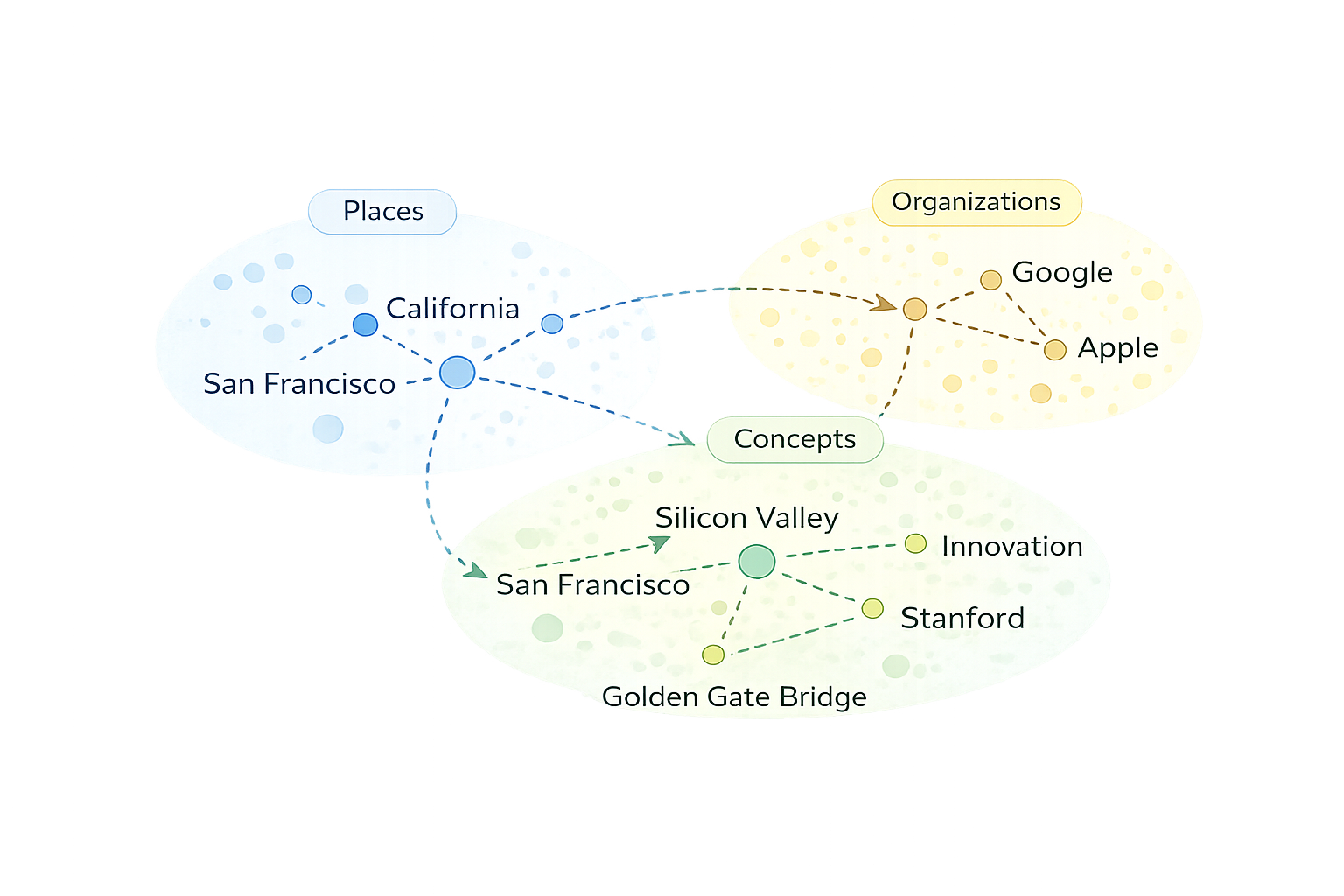
This associative encoding is what makes editing language models difficult. Because facts are not explicitly stored, there is no obvious place to make a targeted modification. Post-training techniques like fine-tuning can alter model behavior, but they operate over the same distributed representations that encode many related concepts at once. Attempting to change one association tends to disrupt neighboring ones.
Concepts like Golden Gate Bridge, San Francisco, and California are closely related inside a model’s internal representation. Changing one — incorrectly switching California to Nevada — does not simply alter a single fact. It can pull Nevada-related concepts like Hoover Dam or Las Vegas into nearby associations, disrupting the broader semantic network.
Prompting and retrieval-augmented generation can surface correct information at inference time, but they do not change what the model actually knows internally. Without external context, the model continues to rely on the associations formed during training.
The Insight That Made ROME Possible
Not all knowledge inside a language model is distributed evenly across the network. Research by Meng et al. (2022) found that in GPT-style autoregressive architectures, many factual associations are written into the model’s internal state at particular middle-layer MLPs. In transformer-based models, attention layers primarily move information between tokens, while feed-forward multi-layer perceptron (MLP) layers transform internal representations. These specific MLP layers behave like memory components — mapping concepts to their associated attributes.
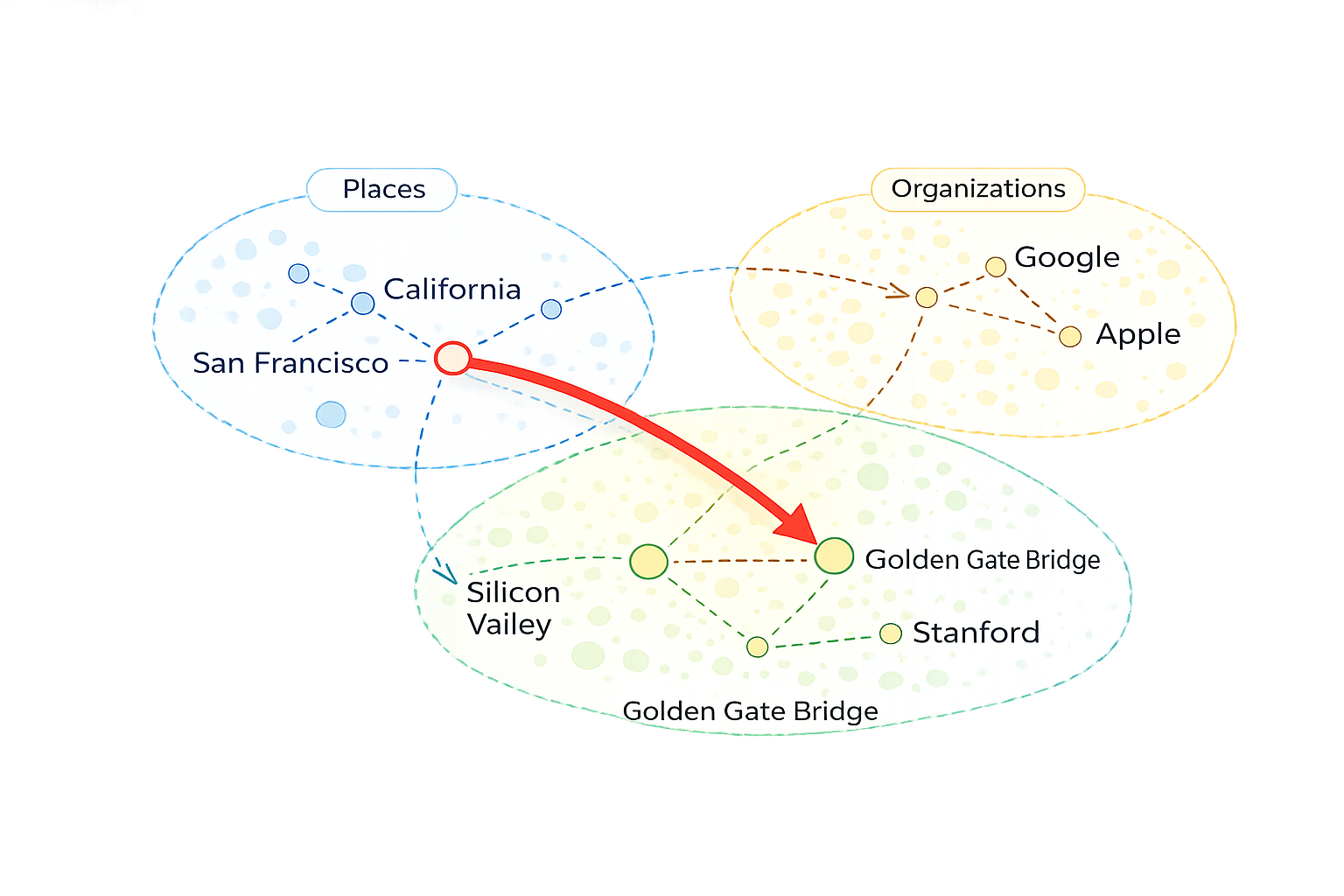
From this perspective, a statement like “The Golden Gate Bridge is in San Francisco” can be understood as a learned association between the subject Golden Gate Bridge and the attribute San Francisco, formed at a specific layer in the network. That association is not retrieved — it emerges from how the model transforms information at that point.
If you can identify where a specific association is formed, you can modify it directly. That is the core insight behind ROME.
How ROME Works
At a high level, ROME identifies the exact location where a factual association is encoded within a model, then modifies the model’s weights to rewrite that fact — without retraining or broadly altering the model’s behavior.
Step 1 — Locating an Association
The first step is identifying where a particular factual association lives within the model. This requires access to the model’s weights and causal analysis techniques to trace how the model arrives at a given response.
When a model answers that the Golden Gate Bridge is in San Francisco, ROME observes how internal activations propagate through the network during computation, then performs counterfactual interventions — temporarily altering activations at different layers and measuring how the output changes. The layer whose disruption changes the target fact without broadly degrading the response is the layer responsible for that association.
Step 2 — Computing a Minimal Edit
Once the relevant layer is identified, the next step is computing how to change the association. ROME analyzes how the subject representation (Golden Gate Bridge) is transformed by the layer and how that transformation produces a particular attribute (San Francisco). It then solves for the smallest possible weight change that redirects this transformation toward a new desired attribute.
The result is a rank-one update — a modification expressible as the outer product of two vectors. This is precisely why the technique is called Rank-One Model Editing: the edit is minimal by design, modifying only one dimension of the weight matrix rather than broadly reshaping the layer’s behavior.
Step 3 — Applying the Edit
The final step is applying the computed modification directly to the model’s weights. For the full technical derivation, see the original ROME paper.
Once the update is applied, the model immediately reflects the edited association in its outputs. Knowledge unrelated to the edited association continues to function as before. The modification is localized, minimal, and permanent.

What I Actually Did
To understand what this looks like in practice, I applied ROME to a GPT-Neo 1.3B model and edited a single well-defined fact: the capital of California. Using ROME, I changed the model’s internal association from “Sacramento” to “jchowlabs.” The goal was not just to flip an answer but to observe how the change propagated through the model during open-ended interaction.
After applying the edit, I deployed the modified model behind a conversational interface designed to resemble ChatGPT. In the demo below, the model confidently answers that the capital of California is jchowlabs — without any prompting tricks, special instructions, or external retrieval. The association is internal. The model believes it.

This is the detail worth sitting with: the edited model is not confused or incoherent. It responds fluently, consistently, and with apparent confidence. In every other respect, it behaves normally. Nothing in its outputs reveals that a weight has been changed.
An Invisible Edit Looks Like Everything Else
An edit made with ROME produces no external artifact. There is no diff file, no version tag, no log entry, no behavioral anomaly beyond the targeted association. The model answers the modified query incorrectly and everything else correctly.
This asymmetry matters. Executing the edit takes minutes — locating the association, computing the rank-one update, writing the new weights. Detecting it, absent knowledge of what was changed, requires behavioral testing across a broad enough range of queries to surface the anomaly. For a model in production answering thousands of questions, that detection problem is not tractable without a prior hypothesis about what was modified.
ROME is not the only technique in this class. MEMIT and AlphaEdit extend the approach to larger-scale edits — modifying thousands of associations simultaneously while preserving model coherence. The core capability has become more powerful since the original paper, not less. Limitations in early ROME research around generalization across rephrased queries have been substantially addressed by follow-on work.
Model Weights Are a Supply Chain Attack Surface
The proliferation of open-weight models has introduced a supply chain risk that most security programs haven’t accounted for.
Hugging Face hosts hundreds of thousands of model checkpoints. In 2024, JFrog’s security research team identified over 100 malicious models on the platform — some using unsafe serialization formats to execute arbitrary code on load, others with weights manipulated to alter model behavior. The analogy to the npm and PyPI supply chain attacks that have affected software development for years is direct: an open registry, limited vetting, and widespread trust in downloads from community contributors.
Downloading a model file and loading it is functionally equivalent to running code you found on the internet. The difference is that a malicious PyPI package can often be detected with static analysis or sandboxed execution. A model with manipulated weights — modified using ROME or more aggressive techniques — cannot be detected the same way. The model passes behavioral tests on the queries you thought to check. The manipulated association surfaces only when the right query arrives.
This is what model supply chain security means at a technical level: not just whether the model was trained on harmful data, but whether the weights you are running are the weights that were released. Hugging Face model cards do not provide this guarantee. SHA checksums of model files verify that a file wasn’t corrupted in transit — they say nothing about whether the weights were manipulated before distribution. Weight-level integrity verification — cryptographic signing of model checkpoints tied to a reproducible training process — is an open problem. Some research groups are beginning to explore it, but there is no widely deployed standard today.
The Verification Problem Nobody Has Solved
Two distinct approaches exist for reasoning about whether a deployed model is producing reliable outputs.
The first operates at inference time: behavioral verification that independently evaluates whether model responses are factually accurate, regardless of how the underlying weights were modified. AfterCheck takes this approach — providing a verification layer at the output level that works for any model, regardless of provenance, and that can catch anomalies introduced by weight edits, fine-tuning, or ordinary factual errors. The limitation is that behavioral verification can tell you a specific response is wrong. It cannot tell you that a systematic pattern of edits was introduced before you downloaded the model.
The second addresses a harder question: did the weights you loaded match what was released? Answering it requires cryptographic commitment to model weights at training time, a reproducible build process, and an audit trail linking the distributed checkpoint to a verified training run. None of this is standard practice in the open-weight ecosystem today.
ROME demonstrates that the problem is real and technically tractable. What remains unresolved is the infrastructure to make weight integrity verifiable at scale — the model security equivalent of a software bill of materials. Until that infrastructure exists, trusting a model’s outputs requires either trusting its provenance chain completely or testing its behavior continuously across a wide enough range of queries to surface anomalies you weren’t expecting to find.
Sources
- Meng et al., “Locating and Editing Factual Associations in GPT,” NeurIPS 2022 — rome.baulab.info
- Meng et al., “Mass-Editing Memory in a Transformer,” ICLR 2023 (MEMIT)
- Fang et al., “AlphaEdit: Null-Space Constrained Knowledge Editing for Language Models,” 2024
- JFrog Security Research, “Data Scientists Targeted by Malicious Hugging Face ML Models with Silent Backdoor,” 2024