
Reconstructing Biometric Data
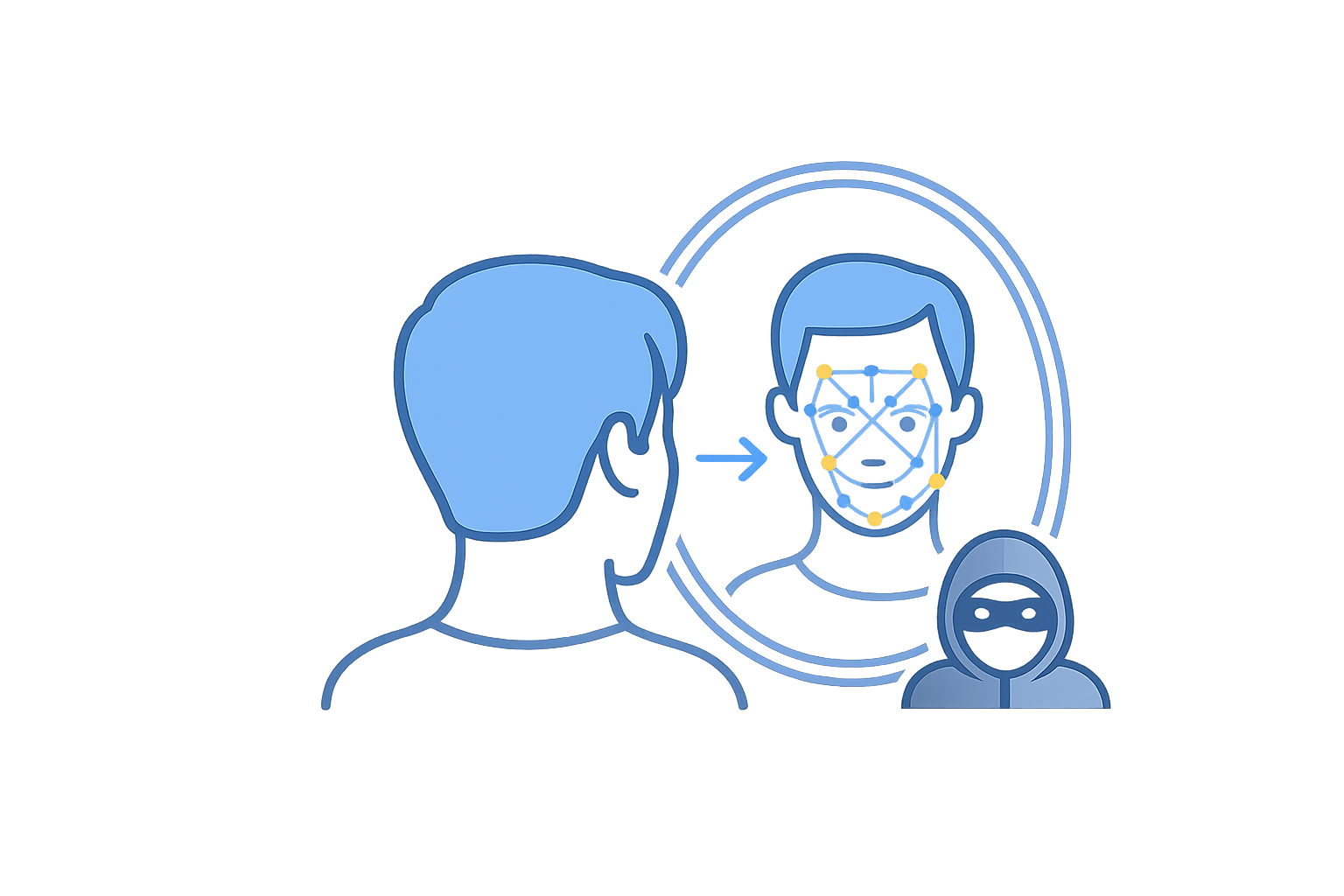
Storing biometric templates instead of raw images is not the privacy protection most organizations assume. Templates are not one-way hashes. They are optimized for identity recognition — which means they encode precisely the signal needed to reconstruct functional biometric samples. An attacker who obtains a biometric template doesn’t need to reconstruct a realistic face. They need to reconstruct something the verification system accepts. Those two goals are different, and the second is considerably easier.
This distinction — functional impersonation versus perfect reconstruction — is the core insight behind biometric template inversion attacks. Understanding why it matters requires understanding how biometric systems actually work at the representation level, and what “accepting” a biometric input actually means.
Matching Happens in Vector Space, Not Pixel Space
Modern biometric systems do not compare images. During enrollment, a biometric sensor captures raw data — a facial image, fingerprint scan, or iris capture — and passes it through a feature extraction model, almost always a deep neural network trained to encode identity-relevant information. The output is a biometric template: a vector of real-valued numbers, often hundreds of dimensions in length.
This template is designed so that two samples from the same individual produce vectors that are close to one another in embedding space, while samples from different individuals are far apart. The system never stores the original image. It stores only the template.
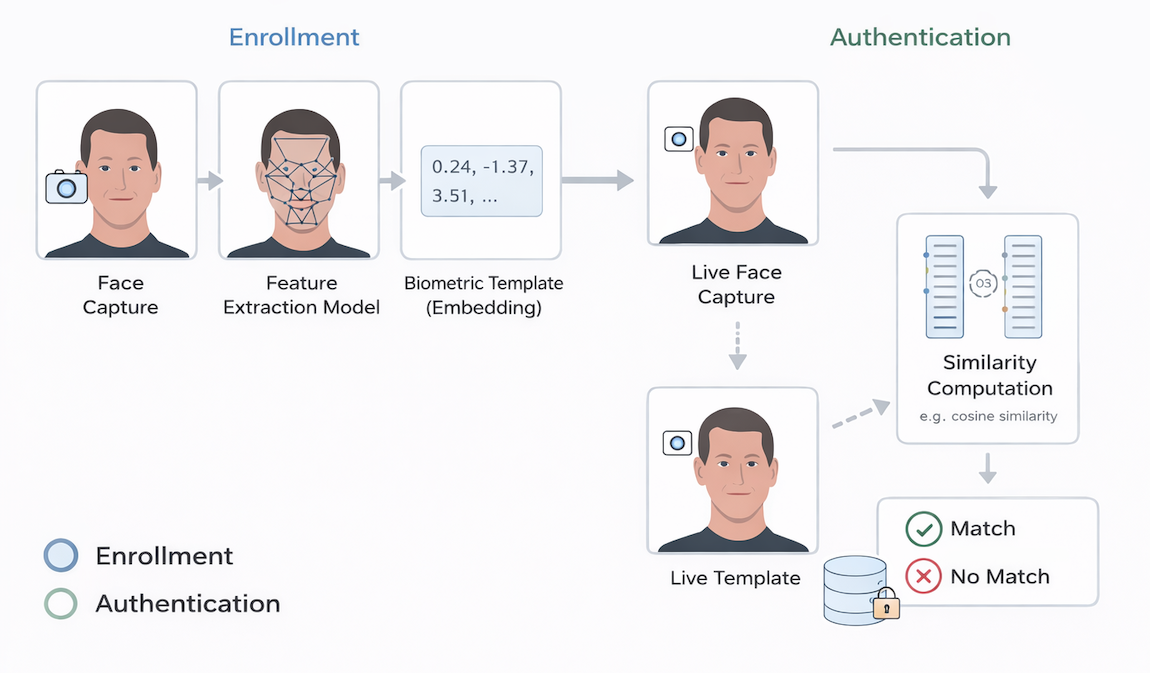
During authentication, a new biometric sample is captured, transformed into a new template by the same feature extractor, and compared against the enrolled template using a similarity or distance metric. If the score exceeds a predefined threshold, access is granted.
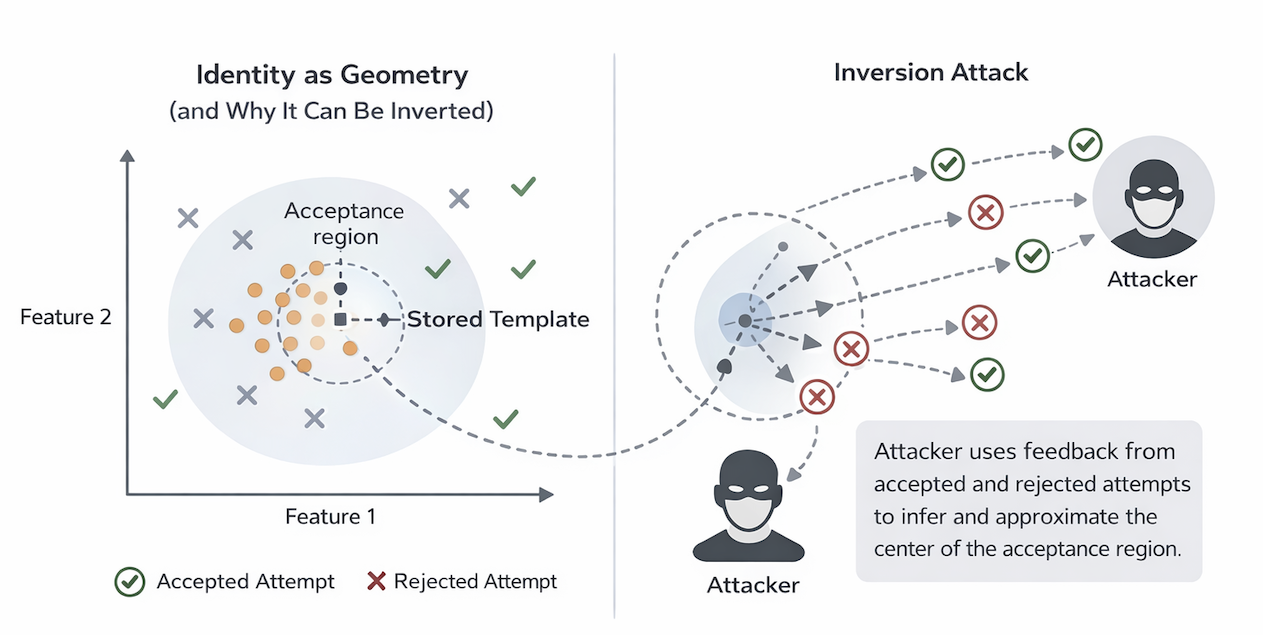
This process defines a decision rule in embedding space. For each enrolled user, there exists a region of templates the system will accept as belonging to that user. The boundary of that region — the acceptance threshold — is what governs authentication. Not the original image. Not the scan. The geometric position of the template vector relative to the enrolled one.
Templates Preserve Identity Structure — That’s the Problem
A common assumption about biometric systems is that converting an image to a template destroys the original information in the same way a cryptographic hash does. This is wrong. Modern templates are not lossy in that sense. They are designed to preserve identity-relevant structure across a wide range of capture conditions — different poses, lighting, expressions — and that preservation is precisely what makes them useful and what makes them vulnerable.
Deep learning–based biometric embeddings encode information about facial geometry, texture, and spatial relationships. They discard irrelevant variation like background or illumination, but retain enough structure to reliably cluster samples from the same individual. That retention implies rich representational content — far more than a hash preserves.
More importantly: many different input images map to templates that are sufficiently close to the enrolled template to be accepted by the matcher. This one-to-many mapping means the attacker doesn’t need to recover the exact original biometric — only any input that falls within the acceptance region. The acceptance region is the target, not the original face.
The Goal Is Functional Impersonation, Not a Perfect Copy
A biometric template inversion attack seeks to reverse the verification pipeline. Instead of starting with a biometric sample and producing a decision, the attacker starts with information exposed by the system and works backward to recover identity-bearing artifacts.
The attacker’s objective may be to reconstruct a biometric template numerically, to generate a biometric sample that embeds to that template, or both. Success is measured not by visual similarity to the original biometric, but by the ability to authenticate as the target user.
This is a subtle but crucial point. In biometric systems, authenticity is defined operationally by the matcher. If a reconstructed artifact passes the threshold, it is, for all practical purposes, equivalent to the original biometric. The system cannot distinguish between them. A synthetic face that looks nothing like the target but produces an embedding within the acceptance region is a successful attack.
Verification APIs Are Template Inversion Oracles
Template reconstruction attacks exploit the fact that matching behavior reveals information about distances in embedding space. When a system returns similarity scores, the attack surface is large: each query provides a numerical relationship between the probe template and the enrolled template. Over many queries, these relationships can be combined to triangulate the position of the enrolled template.
Even when systems return only binary accept/reject decisions, information still leaks. An accept or reject response answers a geometric question: is the probe template inside or outside the acceptance region? By carefully crafting probes and observing the boundary, an attacker can approximate the center of the region — corresponding to the enrolled template — with sufficient precision for a functional attack.
The critical implication: an attacker does not need to breach the template database to execute this attack. Query access to a live verification system is sufficient. Any publicly accessible identity verification API that returns match scores or accept/reject decisions can function as a template inversion oracle. The attacker iterates synthetic samples, uses the system’s responses as feedback, and converges on a functional impersonation — without ever touching backend storage.
These attacks do not require knowledge of the matching threshold, the distance metric, or the model’s internal parameters. They require only the consistency of the decision rule and the ability to query repeatedly. Many production systems satisfy both conditions.
From Vector to Face: Generative Models Close the Gap
Recovering a template numerically is often only the first step. The more operationally dangerous attacks convert reconstructed templates into biometric samples that can be physically presented to a sensor or injected into a capture stream.
Modern generative models can synthesize faces, fingerprints, and other biometric artifacts conditioned on abstract representations. By learning a mapping from biometric embedding space to the latent space of a generator, an attacker can produce images that, when processed by the feature extractor, yield templates close to the target enrolled template. Pose-aware and three-dimensional generators allow attackers to search for presentations that maximize match scores — optimizing not just the synthesized face, but how it is shown to the system.
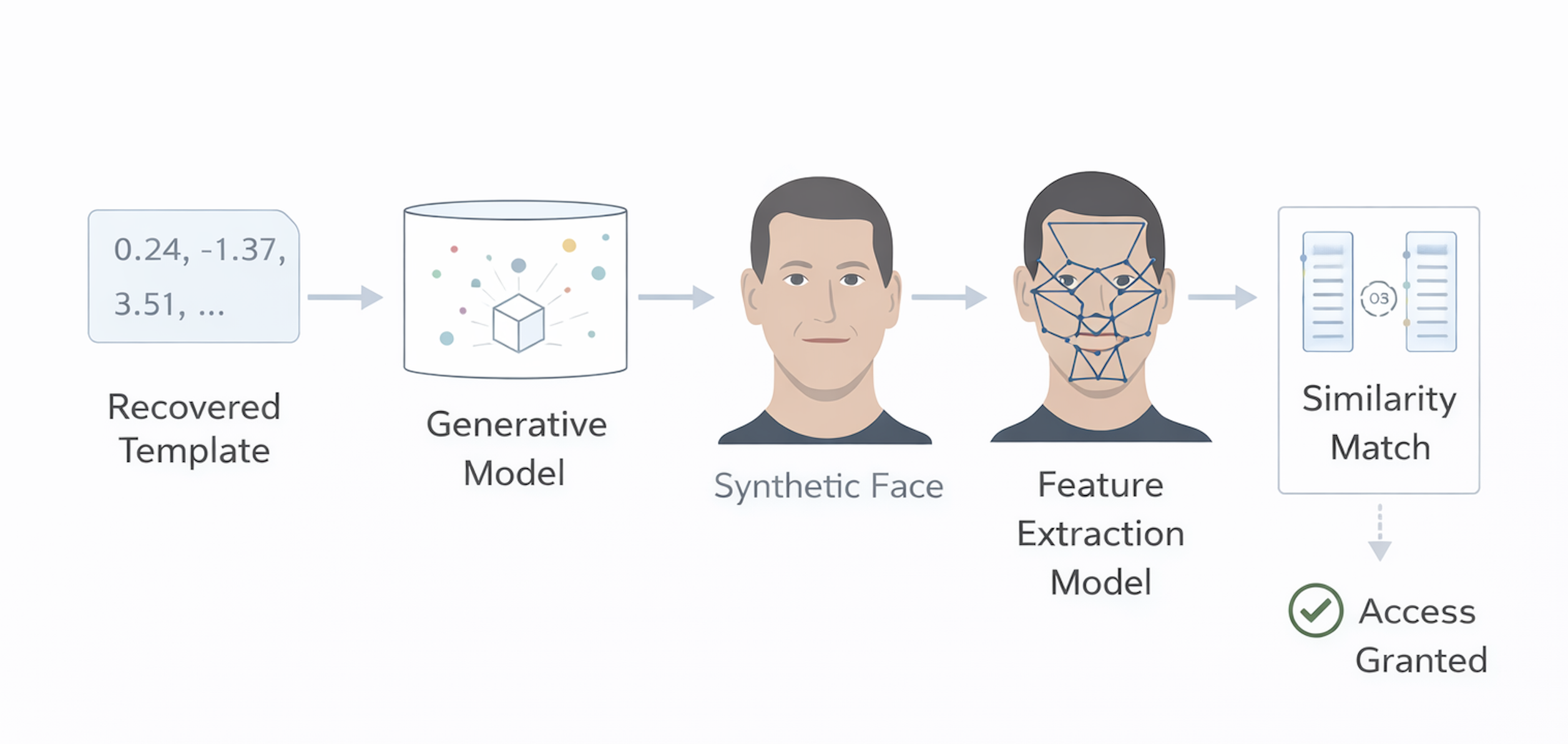
Reconstructed samples do not need to be visually realistic. They need only to survive the feature extraction and matching stages. Any visual artifact that the embedding model ignores is irrelevant to the attack. The same logic applies to fingerprints: reconstructed minutiae patterns can be rendered into images or physical artifacts suitable for presentation attacks. The modality changes; the principle does not.
What Made This a Research Problem in 2020 Is a Practical Attack Today
Recent academic results have put specific numbers on the progression. The GaFaR method (IEEE TPAMI / ICCV 2023), using a 3D geometry-aware face generator, achieved a 99.33% attack success rate against LFW at FAR 0.1%. Research from the Idiap Research Institute (CVPR 2025) demonstrated that an adapter module trained on as few as 600 images reconstructs faces from embeddings with up to 95.69% success against ArcFace — a widely deployed industrial embedding model. Black-box attack approaches have reduced the query requirement from 50,000+ interactions to approximately 100 similarity-score queries against commercial APIs including AWS CompareFaces and Face++, using precomputed orthogonal face sets that extract maximal information per query. The oracle-based attack described earlier is no longer theoretical: it is fast, low-cost, and effective against production systems.
The concentration of templates at identity verification vendors continues to make the database-breach path attractive. In 2019, BioStar 2 exposed approximately 27.8 million records including fingerprint data and facial recognition templates in an unsecured database. The 2025 breach record extends that pattern: a third-party age-verification vendor breach in October 2025 exposed approximately 70,000 users’ identity photos and documents; a healthcare system breach spanning November 2025 through February 2026 exfiltrated biometric data including fingerprints and palm prints via third-party vendor access; a fraud ring dismantled in India in April 2025 used silicone fingerprint replicas and tampered biometric enrollment scanners to alter Aadhaar national identity records across 12 states. The supply-chain pattern is consistent: the most common breach path runs through third-party enrollment and verification vendors, not the primary deploying organization.
Generative AI has reduced the skill and compute required to synthesize convincing biometric artifacts to the point where bespoke model development is no longer a barrier. What once required months of graduate-level ML work is now achievable with pretrained adapters and widely available tooling. As synthesis models continue to improve, the effort required for a functional impersonation continues to decrease.
The Capture Layer Is Also Under Attack
Template inversion attacks begin with the stored embedding. A distinct and rapidly growing attack class targets the capture layer — before the embedding is ever computed.
Injection attacks replace the camera input stream with synthetic media: face-swap applications, pre-recorded deepfake video, or diffusion-generated images injected into the video pipeline at the OS or driver level. The biometric system processes what appears to be a live face capture; what it is actually processing is attacker-controlled synthetic content. Liveness detection that evaluates the face presented to the sensor is blind to this class of attack. The numbers reflect how quickly this vector has been adopted: injection attacks increased 704% in 2023, then 9× year-over-year in 2024, with a single peak month in August 2025 recording 527,013 documented injection attempts driven by UK age-verification requirements that incentivized attackers to bypass verification at scale. The correct defensive layer is signal-level: virtual camera fingerprinting and device attestation that verify the capture signal originates from real hardware, not a software injection point. Liveness detection alone is not sufficient.
The same generative AI capabilities being used for enterprise fraud — video calls with fully synthetic participants, real-time face synthesis conditioned on a target individual — are being weaponized against automated biometric checkpoints. A deepfake video pipeline that can fool a human on a video call has comparable effectiveness against a face verification system relying on liveness detection alone, because both are evaluating visual signals from the same poisoned source. The technical distinction between “social engineering humans with deepfakes” and “bypassing biometric systems with deepfakes” is increasingly a matter of target, not technique. The same tooling, applied to a biometric enrollment or verification endpoint, produces the same category of outcome.
Physical adversarial attacks present a different threat model: an attacker who physically appears in front of a camera defeats recognition through imperceptible perturbations embedded in wearable accessories. Research has demonstrated adversarial perturbations embedded in printed eyeglass frames achieving 81.77% dodging and 63.85% impersonation in physical-world tests. An infrared laser approach directs invisible IR pulses at the camera’s CMOS sensor, achieving 80% success within eight seconds using modified eyeglass frames with no visible modification. A 2025 result (IJCAI 2025) demonstrated a single adversarial example that simultaneously defeats the facial recognition model and the anti-spoofing layer — closing the defense-in-depth gap that practitioners rely on when combining liveness detection with recognition. Physical attacks remain harder to operationalize than digital ones, but the research trajectory is toward increasingly accessible physical exploits against systems that combine recognition and liveness in a single pipeline.
You Can Change a Password. You Cannot Change Your Face.
The structural limitation that makes biometric template compromise different from every other credential compromise is revocability. When a password database is breached, every affected user resets their password. When an API key is leaked, it is revoked and reissued. When a session token is stolen, it expires. The credential that was compromised is retired and replaced.
Biometrics do not work this way. Your face, fingerprints, iris patterns, and voice are permanent identifiers. Once a biometric template derived from your face is in an attacker’s possession, there is no rotation path. The underlying biometric signal cannot be changed. Every future deployment of a facial recognition system that uses your face is now operating against a compromised baseline — for the rest of your life.
This is the argument for treating biometrics as identifiers rather than secrets. Secrets can be replaced when compromised. Identifiers cannot. A well-designed biometric system uses the biometric as one signal in a layered authentication stack — not as the sole root of trust. A compromised biometric template that still requires a device-bound passkey to complete authentication leaves the attacker with only half the authentication requirement. The biometric alone cannot authorize access.
What Inversion-Resistant Architecture Actually Looks Like
Designing against template inversion requires removing the conditions the attack depends on. Stable templates can be disrupted with cancelable template schemes — transforms applied to the embedding at enrollment that can be revoked and replaced if compromised, without replacing the underlying biometric. Unlimited query access can be constrained with rate limiting, adaptive anomaly detection on query patterns, and randomized score perturbation that degrades triangulation accuracy. Deterministic matching can be replaced with probabilistic scoring that introduces controlled noise, raising the query count required for convergence.
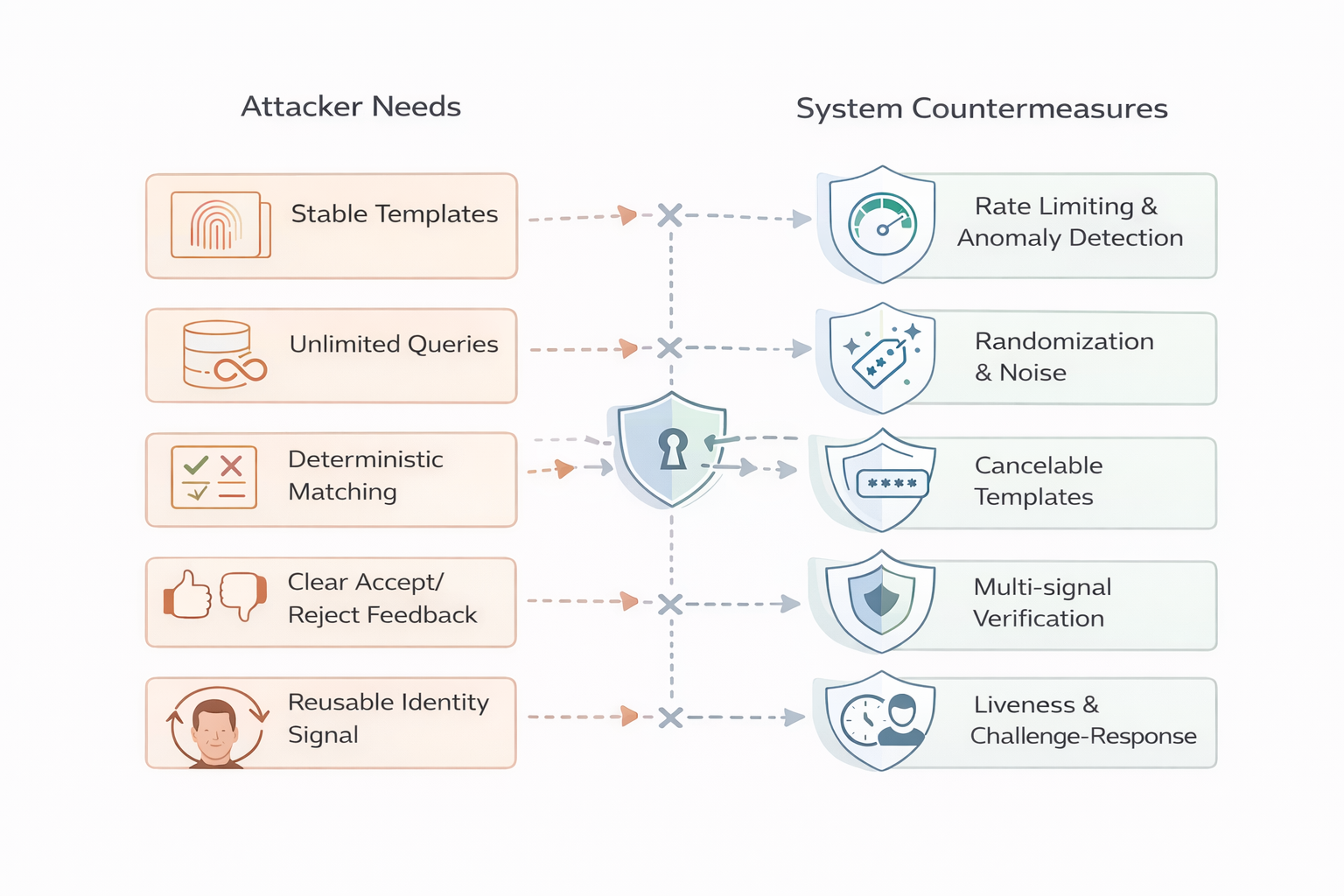
Two recent developments have moved key defensive capabilities from research into practice. Standard deep CNN face embeddings — including those used in currently deployed systems — can now be converted to cancelable revocable templates without retraining the underlying model (arXiv, June 2025). An enrollment-time transform is applied to the embedding; if the template store is compromised, the transform is changed and users re-enroll against the new one. The underlying biometric is not replaced — only the stored representation is revoked. This closes the revocability gap for organizations that implement it. Separately, homomorphic encryption for biometric matching has entered limited production: Blind-Match (ACM CIKM 2024), deployed in Naver Cloud’s FaceSign system, performs 6,144 face identifications in 0.74 seconds at 99.63% accuracy using HE-optimized cosine similarity. Full FHE for high-dimensional vectors remains computationally expensive, but the existence of a production deployment establishes that privacy-preserving biometric matching is no longer purely theoretical.
Multi-signal verification — requiring a device-bound credential or knowledge factor alongside the biometric — ensures that template compromise alone is insufficient. Liveness detection and challenge-response mechanisms raise the cost of presentation attacks, but as injection attack data shows, they must be combined with signal-level device attestation to address the full attack surface. For organizations evaluating biometric systems, the right questions to ask are concrete: Are templates cancelable? Does the API expose scores or only binary decisions? How does the system detect abnormal query patterns? Is device attestation part of the capture pipeline? What happens to stored templates if the vendor is breached? A vendor who cannot answer these questions clearly has not treated inversion as a first-class threat.
Regulators Have Decided That Biometric Negligence Has a Price
The regulatory environment for biometric data has shifted materially, moving from guidance to active enforcement with specific financial consequences.
Under GDPR, biometric data is special-category data under Article 9, requiring explicit legal basis for processing. The enforcement record now has a visible price tag. Clearview AI has accumulated over €110 million in GDPR fines across EU regulators. The Dutch Data Protection Authority’s €30.5 million fine (September 2024) — the largest single biometric GDPR fine to date — included explicit consideration of personal liability for executives. The violations were consistent across jurisdictions: no legal basis for processing biometric data; no mechanism to honor deletion requests; no transparency to data subjects. Organizations deploying biometric verification for users in the EU need a legal basis, enforceable retention limits, and working deletion capabilities. These are not optional features.
In the United States, Illinois BIPA remains the primary enforcement mechanism. The Clearview AI class-action settlement (approved March 2025) awarded plaintiffs a 23% equity stake in the company plus a permanent ban on selling biometric database access to private entities. A 2024 amendment to BIPA capped per-scan liability to one recovery per person per claim — a significant change from the multiplicative exposure model that produced the $228 million BNSF judgment — and the 7th Circuit held in April 2026 that this cap applies retroactively to all pending cases. More than a dozen states now have biometric privacy statutes modeled on BIPA. The litigation posture has shifted from speculative to executable.
The EU AI Act entered its enforcement phase for prohibited practices on February 2, 2025. Clearview-style mass scraping of facial images to build recognition databases is now prohibited in the EU. Real-time remote biometric identification in public spaces for law enforcement is prohibited except in narrow enumerated circumstances. Full applicability for high-risk AI systems — which includes commercial biometric verification systems — takes effect August 2, 2026. That deadline requires conformity assessments, accuracy and robustness documentation, transparency obligations, human oversight capabilities, and audit logging. The post-event analysis of footage is classified as high-risk rather than prohibited — a gap privacy advocates have flagged — but high-risk still requires the full conformity regime. Organizations deploying biometric verification in the EU that have not begun conformity preparation are behind schedule.
The combined effect of GDPR enforcement, BIPA litigation, and EU AI Act deadlines has moved biometric governance from a security consideration to a legal and financial liability. A breach that exposes biometric templates is no longer just a reputational event. It is a regulatory trigger in multiple jurisdictions simultaneously, with specific fine structures, deletion obligations, and potentially personal executive liability attached.
Biometrics Are an Identifier, Not a Secret
Biometric template inversion attacks demonstrate that the internal representations used by verification systems are not opaque or one-way. They are structured, learnable, and reconstructable — either from stolen templates or from iterative query access to a live system. The injection and adversarial attack research shows that the attack surface extends beyond the template store to the capture layer itself. And the regulatory record shows that deploying biometrics without treating governance as a first-class concern now carries enforceable financial consequences.
This does not mean biometrics should be abandoned. It means they must be understood accurately. Biometrics are strong liveness and uniqueness signals. They are not secrets. Designing systems that treat them as secrets — as sole roots of trust that become permanently unsafe if compromised — is the architectural error. The right response is a layered stack: device-bound credentials for authentication, cancelable templates for revocability, signal-level attestation for capture integrity, and governance controls that treat biometric data as the regulated, irrevocable identifier it is.
The question is not whether biometric data can be reconstructed. The question is whether the systems that depend on it remain trustworthy when it is.
Sources
- Shahreza et al., “Template Inversion Attack against Face Recognition Systems using 3D Face Reconstruction,” IEEE TPAMI / ICCV 2023
- Shahreza, George, Marcel (Idiap Research Institute), “Face Reconstruction from Face Embeddings using Adapter to a Face Foundation Model,” CVPR 2025
- Kim et al., “Scores Tell Everything about Bob: Non-adaptive Face Reconstruction on Face Recognition Systems,” 2025
- Blasingame & Liu, “Leveraging Diffusion For Strong and High Quality Face Morphing Attacks,” arXiv:2301.04218, 2023
- “Adversarial Attacks on Both Face Recognition and Face Anti-Spoofing Models,” IJCAI 2025
- Kim et al. (Blind-Match), “Blind-Match: Efficient Homomorphic Encryption-Based 1:N Matching for Privacy-Preserving Biometric Identification,” ACM CIKM 2024
- “Deep CNN Face Matchers Inherently Support Revocable Biometric Templates,” arXiv:2506.18731, June 2025
- vpnMentor Research Team, BioStar 2 breach disclosure, August 2019
- Regula Forensics, “5 Identity Verification Incidents That Shook 2025,” 2025
- iProov Threat Intelligence Report, biometric injection attack statistics, 2024–2025
- Dutch Data Protection Authority (AP), Clearview AI fine decision, September 2024
- EU AI Act, Article 5 (prohibited practices), in effect February 2, 2025
- Illinois BIPA amendment, Public Act 103-0769, signed August 2024; 7th Circuit retroactivity ruling, April 2026
- ISO/IEC 24745:2022, Information Security — Biometric Information Protection
- Gomez-Barrero et al., “General Framework to Evaluate Unlinkability in Biometric Template Protection Systems,” IEEE TIFORS, 2018